
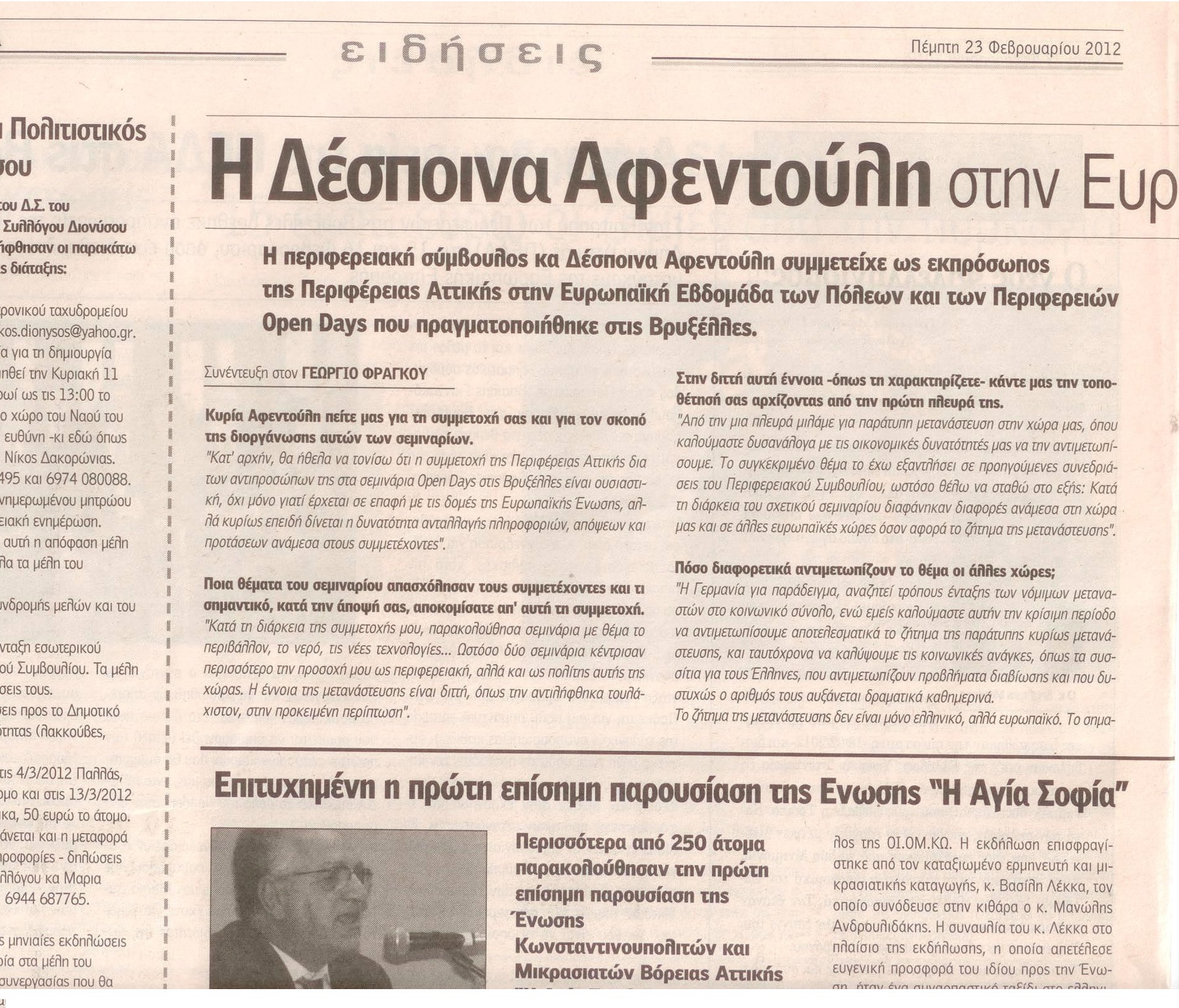
Despina Afentouli at the European Week of Cities and Regions – interview to ATTIKO VIMA
 Published: February 23, 2012
p. 6-7, Column: NEWS
The city councilor, Mrs. Despina Afentouli participated as representative of Attika Region at the European Week of Cities and Regions Open Days which took place in Brussels.
Interview to Georgios Fragkou
[Picture of Despina Afentouli]
Mrs. Afentouli tell us about your participation [in the seminars] and about the cause of organizing these events.
“First of all, I would like to highlight that the participation of Attica Region via its representatives in the Open Days seminars in Brussels is substantial, not because one [representative] come into contact with the European Union functions, but basically because the participants have the chance to exchange information, views and proposals”
What were the subjects of the seminars that the participants were occupied with and what was crucial, according to your opinion that you gained from your participation.
“During my participation, I attended seminars on the environment, the water, the new technologies… However two seminars attracted more my attention as a regional [councilor], but also a citizen of this country [Greece]. The concept of immigration is double, as I realized it, at least, at this certain occasion”.
The double concept – as you characterize it- [please] explain it, beginning from its first side.
“On the one hand, we talk about the irregular immigration in our country, where we are called – disproportionately to our financial capabilities – to face it.
I have thoroughly talked about this specific subject during previous sessions of the Attica Region Council, however, I would like to stress this: During this specific seminar there were differences between our country and other European countries on the immigration issue”.
How differently is this issue [of immigration] faced by other countries?
“Germany, for instance, is looking for ways how to integrate the legal immigrants to the society, whereas we are called this critical time to face this issue of irregular basically immigration efficiently, and at the same time to answer to social needs, such as common meals for Greeks, who face survival problems and unfortunately, the number of those in need is increased day by day.
The immigration issue is not only Greek, but also European. The most crucial thing of all, according to my view, is however, the preservation of the social coherence. And to face [this issue] collectively, there is need to reallocate the irregular immigrants within the European Union countries, according to financial, populational, geographical, and other criteria”.
Greece, over the last years, has been fortified behind a disappointing policy regarding the combat the plague of this specific type of immigration, do you think that it is time to face it?
The “key” for the efficient combat of irregular immigration in our country is the amendment of the Dublin II Regulation, as according to this specific regulation is predicted the return of the irregular immigrants to the first [European] country they entered. On my written question towards the European Union, the reply I got was that the Dublin II Regulation is under amendment, so I believe that we should focus on that”.
Let’s get now to the other side of immigration.
On the other hand, there is the immigration of the Youth that is called to raise overwhelming barriers because of the bad practices and policies of the past. The hope of our country, young people, are forced to look for a job abroad because of the explosive rate of unemployment in the country. Today, [the young people] they do not immigrate as migrant workers, as it happened in the past, but basically as academic personnel or even in higher positions. As it was mentioned during that seminar, the most important issue that arises in other European countries regarding employment is the need to face the phenomenon of school leaving [before graduating], as well as of stopping their studies [before graduating]”.
According to your point of view, what should change and to which fields should the country focus its attention.
“I submitted, however, the Greek side regarding the work offer in the country [Greece] for young people with high level of education. I stressed that the issue that arises in Greece is that most young Greek people are highly educated, but unfortunately, there is not a relevant job offer, as a result the most active part of society, young people, to be forced to immigrate abroad to find a job, whereas they could contribute effectively to the economic recovery of Greece, taking into account the low birth rate in the country. Young people, at least during their most productive phase of their lives, should at least have the chance to choose the country where to deliberate their powers and not to be shown the exit”.
*Despina Afentouli is sociologist (Ph.D.) – journalist and regional councilor of Eastern Attica.
Source: ATTIKO VIMA (in Greek: ΑΤΤΙΚΟ ΒΗΜΑ)