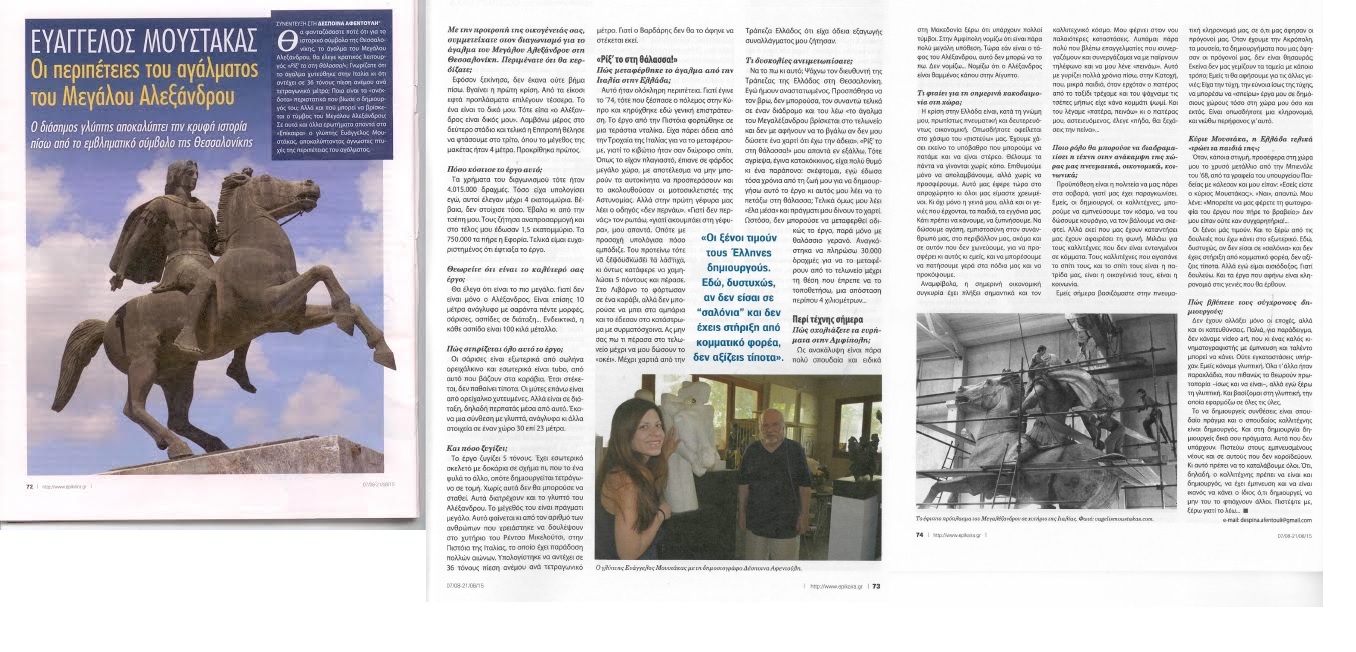
Evaggelos Moustakas: Adventures of the statue of Alexander the Great – Interview to D.Afentouli/Epikaira
August from 7th to 21st, 2015
Subtitle: The famous sculptor reveals the secret story behind the emblematic symbol of Thessaloniki
Interview to Despina Afentouli
e-mail: [email protected]
Would you ever imagine that for the historical symbol of Thessaloniki, the sculpture of Alexander the Great, a state official would say “Throw it [the sculptor] to the sea!” Did you know that the statue was cast in Italy and that it withstands 36 tons of wind pressure per square meter? What are the “anecdote” incidents that the sculptor has been through? And where might be the tomb of the Alexander the Great? To these and other questions replies to the Epikaira the sculptor Evaggelos Moustakas, revealing the unknown adventures of the statue.
Interview on p.p.: 72, 73, 74.
Picture on p. 72 [The Statue of Alexander the Great in Thessaloniki]
Picture on p. 73 – subtitle: The sculptor Evaggelos Moustakas with the journalist Despina Afentouli.
Picture on p. 74 – subtitle: The horseback scale model of Alexander the Great in a foundry in Italy. Photo: vagelismoustakas.com
With the encouragement of your family, you participated in the competition for the statue of the Alexander the Great in Thessaloniki. Did you expect that you would win?
Since I started, I did not take, not even one, step backwards. The first judgement comes out. Out of twenty, seven patterns are chosen. One of them is mine. Then I said “The Alexander is mine”. I participated in the second phase and finally, the [judge] Committee decided to reach the third phase, the pattern’s size was 4 meters. I was qualified first.
How much did this work cost?
The money of the competition was 4.015.000 drachmas. That was their appreciation, they were saying up to 4 million. Of course, it did not cost that much. I also paid out of my own pocket. I asked them for revaluation and at the end they gave me 1,5 million [drachmas]. 750.000 [drachmas] were taken by Internal Revenue Service. I am finally happy that I made the work.
Do you consider it as you best work?
I would say that it is the biggest. Because it is not only the Alexander the Great. It is also 10 meters embossed [work] with forty five forms, sarisas, shields in a row… To characteristically mention that each shield weights 100 kilos of metal.
Where is all this work based?
The sarisas are on the outside [made] of brass tube and on the inside is tubo, from the one they use for the boats. So it stands, nothing happens to it. The edges on top are made of bronze melt. But these are in a row, which means that you walk within it. I made a synthesis out of sculptures, embossed [works] and other elements in a space of 30 x 23 meters.
And how much does it weight?
The work weights 5 tones. It has internal frame with beams in a Π shape, where one protects each other, so a square is being created in cut. Without these it could not stand. These run the Alexander the Great statue as well. Its size is indeed big. This is also obvious because of the number of people which had to work at the Renzo Michelucci art foundry in Pistoia of Italy, which has many centuries tradition. It has been estimated that it stands 36 tons of wind pressure per square meter. Because Vardaris [the northwest wind in Thessaloniko, northern Greece], would not let it stand there.
[Subtitle:] “Throw it [the sculptor] to the sea!”
How was this sculptor transferred from Italy to Greece?
That was a whole adventure. Because it happened it ’74, it was when the war in Cyprus out broke and here [in Greece] general mobilization was declared. The work was loaded to a great truck from Pistoia. I had the permission from the Italian police to transfer it, because the shipping crate was big as a duplex house. As they had it slanted, its width was taking a lot of space, and as a result of this, the cars could not overpass [it] and it was followed by Police motorcyclists. But at the first bridge, the driver [of the truck] told us that “I don’t pass [the bridge]”. I asked “Why don’t you pass?”, [and he said] “Because it will reach [the maximum height of] the bridge”. Then, I calculated cautiously how much [of the height of the shipping crate] was obstructing it. I then proposed him to go flat the tyres, and indeed, he managed to go flat 5 points and he passed. They loaded it in Livorno onto a boat, but it could not fit in the holds and they tied it with wire ropes at the deck. Let me better not tell you what I have been through at the customs until they approved everythink was “OK”. They even asked [to show] them papers from the Bank of Greece that I have the permission of currency export.
What kind of difficulties did you face?
Can I say that as well? I am looking for the manager of the Bank of Greece in Thessaloniki. I was upset. I tried to find him, I could not, I finally meet him in a corridor and I tell him “the Alexandre’s the Great statue is at the customs and they will not let me to take it if you do not give me a letter that I have the permission. “Throw it [the sculptor] to the sea!” he replied to furiously. Then I became wild, I turned red, I was very angry and I complained: I think, it took me so many years out of my life to create this work and he tells me to throw it to the sea? He finally tell me “come in” and he indeed gave me the letter. However, the work could not be transferred by car, but only with sea heaver. I had to pay 30.000 [drachmas] to transfer it from the customs to the position is was supposed to be placed, a distance of 4 kilometers…
[Subtitle:] About art today
How do you comment the findings in Amphipoli?
As a discovery it is very great and especially in Macedonia I know that there are many tombs. I think it is a very great case in Amphipoli. Now if it is the tomb of the Alexander [the Great], I cannot say that. I do not think so. I think the Alexander [the Great] is buried somewhere in Egypt.
What led to the current bad situation in the country [Greece]?
The crisis in Greece is, according to my point of view, first of all spiritual, and then economic. This happens undoubtedly due to the loss of our “belief”. We have lost that background which we can refer to and it is solid. We want everything to be done without effort. We want only to enjoy, but not to offer. This brought us to nowhere and we are all in debt. And not only my generation, but also the forthcoming generations, the children, our grandchildren. We have to do something, to wake up. To offer love, trust to our fellowmen, to our environment, even to the one we do not like, so that he could offer to us, and to be able to stand firm and prosper.
Undoubtedly, the current economic situation has affected greatly the art world as well. This brings me back to older situations. I feel deeply sorry to see professionals I was co-operating with to call me and tell me “I am hungry”. This brings me back many years ago, at the Occupation, where [we were] little kids, when my father was coming [back home] from a trip, we were running towards him, searching his pockets if he had a piece of bread. And we were telling him, “dad, I’m hungry, and my father, as a joke, would say “jump, you we forget the hunger”…
What role could the art play to the recovery of our country, spiritually, economically, [and] socially?
Provided [first] that the state will take us seriously, because it has sidelined us. We, the creators, the artists, we could inspire the people, to encourage them, to make them think. But to the point they have brought us, they had taken away from us [our] voice. I am talking about the artists who are not subscribed to political parties. [I am talking about] the artists who love their home and their home is our country, their family is the society.
We are nowadays based on our spiritual heritage, on what our ancestors have left us. When we have the Akropolis, the museums, the creations have been inherited by our ancestors, are they not treasure? Aren’t all these which put money somehow to the cashiers? What are we going to leave to the next generations? I had the luck, perhaps the good luck, to be able and “spread” my [art] works in public places, not only in my country, but also abroad. It is definitely heritage and I feel proud of it.
Mr. Moustakas, does Greece after all throw back its children?
When, at some point, I offered to my country the gold medal from the Bienalle of ’68, they called me from the Ministry of Education office’s and they told me: “Are you Mr. Moustakas? I replied, “Yes”. They told me: “Could you please bring us the picture of the [art] work which was awarded?” They do not even told me congratulations!
The foreigners honor us. And I know that from the works I had done abroad. Here [in Greece], if you are not in the riches and if you are not supported by a political body, you do not deserve anything. But I am optimist. Because I work. And the [art] works I leave behind is heritage to the forthcoming generations.
What do you think about contemporary creators [artists]?
Not only have the times changed, but also the directions. In the past, for instance, I would not do video art, which is something that could also be done by a good cinema artist, who is inspired and talented. Not even the installations existed. We were doing sculpture. All the other things were spin offs, which probably they are considered innovations – and perhaps they are – , but I know sculpture. And I am based on sculpture, which I implement to all materials.
To create compositions, it is a great thing and the great artist is creator. And in the creativity, you make your own things. The ones that do not exist. I believe in the inspired young people and to those who do not deceive. And this is something we have all to understand. That, in other words, the artist has to be a creator as well, to be inspired and to be able to create whatever he/she creates by himself/herself, not to let other do his own creation. Believe me, I know, why I say that…
Source: Epikaira – Current [in Greek: Επίκαιρα]
www.epikaira.gr